UNODC Joint Constructive Dialogue with Relevant Stakeholder
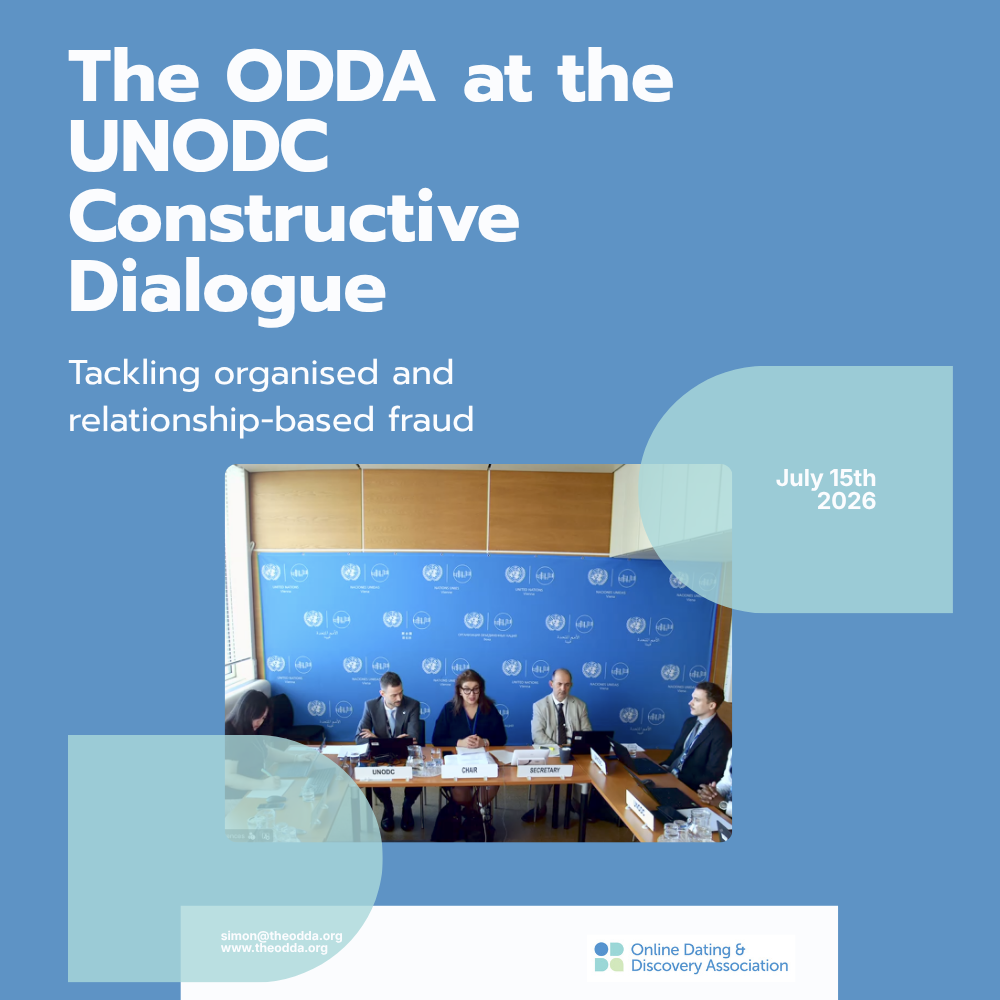
On 15 July 2026, Lauren Sharp represented the ODDA at the UNODC Joint Constructive Dialogue with Relevant Stakeholders, held virtually via Microsoft Teams.
The dialogue followed the conclusion of the 17th meetings of the Working Group of Government Experts on Technical Assistance and the Working Group on International Cooperation, and forms part of the formal mechanism by which non-governmental stakeholders — NGOs, academia and the private sector — contribute to the review of the United Nations Convention against Transnational Organized Crime (UNTOC, the Palermo Convention) and its protocols.
The programme covered a briefing from the UNTOC Review Mechanism Secretariat on the current status of the country review process, a briefing from the UNODC Civil Society Unit on non-governmental engagement, and two panel discussions: one on the tools of the Convention for responding to organised fraud, and one on trafficking in cultural property.
Observations from the dialogue feed into a written Chair’s summary submitted to both working groups and published on the UNTOC Review Mechanism webpage. This was the fifth cycle of such dialogues, and the first held entirely online; over 250 stakeholders registered, including 190 NGOs, 40 private sector representatives and 18 academic institutions.
UN fraud policy discussion
Fraud is being reframed around relationship-building. Discussion at UN level is now centred on authorised push payment fraud — where the account holder authorises the transfer themselves after being manipulated. The manipulation model described is no longer a single high-pressure contact but weeks of sustained relationship-building across multiple channels. Romance and relationship-based fraud is being treated as the dominant pattern rather than a subcategory. Fraud is currently cited as around 45% of all recorded crime in England and Wales.
The prevention stack has a hole where platforms sit. Detection capability at the device and telecom layer — identity checks, SIM-swap detection, exposure signals — stops at end-to-end encrypted messaging, which is where the relationship-building happens. This is being described as a structural limit rather than a resourcing or information-sharing failure. The emerging model is three layers working together: pre-contact signals, transaction-moment behavioural detection, and post-incident victim reporting. The pre-contact layer is the platform layer, and it has no established data-sharing infrastructure equivalent to the financial sector’s.
Cross-institution flagging works. Banking data-sharing networks operating in several European markets report that a flagged individual takes on average nine days to attempt onboarding at another institution, and typically uses at least three institutions before being stopped. Where these networks exist, red-flag exchange time drops from months to roughly fifteen minutes. The consistent finding is that the blocker to establishing them is operational rather than legislative: the same legislation applies across neighbouring markets, and the difference between one that launches a network in months and one where nothing happens is whether someone in the sector takes the lead. The implementation pattern also turns out to be portable — procurement requirements, use cases and governance arrangements are close to identical from country to country, so each new market is adapting an existing template rather than starting from scratch. The parallel to cross-platform notification of banned or prohibited individuals is direct.
Reporting fragmentation is a recognised harm in itself. Victims are routinely bounced between telcos, banks and law enforcement, each with separate reporting lines and internal procedures. Every actor behaves correctly and the victim still loses. Unified reporting frameworks with civil society as referral partners are being pushed as the fix.
Victim harm is being quantified. Roughly half of fraud victims seeking specialist support require clinical intervention. Around 55% report anxiety and 60% report negative mental health impact — figures practitioners consider conservative. Documented cases of suicide following fraud victimisation where no support pathway existed were raised. The framing gaining traction: financial recovery and psychological healing are different things, and systems currently deliver neither past case closure. Re-victimisation via recovery scams is a recognised secondary harm.
Formal recommendations adopted. Fourteen recommendations on organised fraud were adopted, covering victim-centred response, strengthened public-private partnerships, interagency and cross-border information sharing, and specialised national fraud units modelled on financial intelligence units with single country focal points.
The review mechanism for the UN Convention against Transnational Organized Crime remains slow. The Secretariat reported that, of 190 States Parties, three country reviews are complete, with a fourth close to finalisation, and 124 reviews currently active against 62 inactive. Civil society representatives were markedly less positive: several noted that no review group has reached the 70% completion threshold needed to advance to the next cluster of articles — international cooperation, the core of the Convention — meaning it is unclear when that phase will begin, against an original aim of completing the process by 2030. The diagnoses offered differed. Civil society speakers pointed to a lack of political will rather than resourcing. The Chair acknowledged the lag but attributed it in part to technical problems with focal point engagement and reviewer availability, noting that some countries have requested repeat draws because their assigned reviewers were not engaging.
The ODDA continues to engage proactively with the UN and other organisations around the world to tackle fraud as part of our commitment to make online dating and social discovery the safest place to meet people.